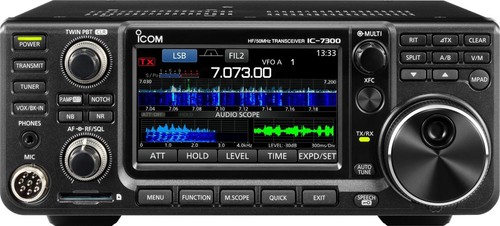
- Transmit power
- Icom rates it at 2 to 100 W on SSB, CW, RTTY and FM, and 1 to 25 W on AM, on every band from 160 m to 6 m. Ask for a wattmeter reading into a dummy load on 80 m, 20 m, 10 m and 6 m. A radio that only powers on hasn't proved its transmitter.
- Receiver
- It receives 30 kHz to 74.8 MHz, with SSB sensitivity of 0.16 µV on HF and 0.13 µV on 6 m with the preamps on. Ask for a short video of the scope and waterfall on several bands with an antenna connected. A band that shows no signals or noise while the others do points at a fault in that band's filter or switching.
- Finals
- Icom's service manual shows a push-pull pair of RD70HVF1C MOSFETs (Q131 and Q132) in the final, driven by an RD15HVF1. The meter can show drain voltage (VD) and drain current (ID), so a photo of the ID meter at full power into a dummy load is a useful extra.
- Power supply
- It runs on 13.8 V DC ±15% and draws up to 21 A at 100 W, so the supply needs to be rated for at least that. Icom's matching supply is the PS-126 (13.8 V, 25 A). There's no AC supply inside.
- Dial and display
- Everything runs through a 4.3-inch color touch screen with the scope and waterfall. Ask for a video of the screen and main dial in use. Icom's support notes say the clock forgets the time until the internal backup battery has charged with the supply left on for a week, so a wrong clock alone isn't a fault.
- Filters and options
- Filtering is digital, so there are no crystal filters to add. The antenna tuner, keyer and RTTY decoder are built in. What sets one listing apart is the firmware version, shown in the menu, and whether it's the original IC-7300 or the 2025 IC-7300MK2.
Check the listing photos against this list, and ask the seller about anything you can’t see. A missing piece should come off the price.