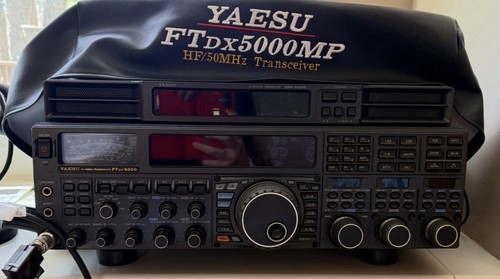
- Transmit power
- Yaesu rates it at 10 to 200 W on SSB, CW, FM and data, 5 to 50 W AM carrier, and 75 W in class A. Ask for a wattmeter reading at full power on 160 m, 20 m, 10 m and 6 m, into a dummy load rated for 200 W. Each band should reach full power and hold it.
- Receiver
- There are two complete receivers. The main one on VFO-A uses a 9 MHz first IF with crystal roofing filters, and the sub receiver on VFO-B is triple conversion with a 40.455 MHz first IF and its own AGC. Ask whether both hear signals on every band from 160 m to 6 m, and both at once in dual receive.
- Finals
- Yaesu's manual says the 200 W stage is a push-pull pair of ST SD2931 MOSFETs running at 50 V, cooled by a 92 mm thermostatic fan. The radio shows HI-SWR when the SWR passes 3:1 and the tuner can't match it. Ask whether that warning has ever come up.
- Power supply
- The AC supply is built in and takes 90 to 264 V, so it plugs into the wall with the supplied cord. It draws up to 720 VA on transmit. Check the cord is in the photos and ask whether the fan runs when it warms up.
- Dial and display
- Beside the main display are three EL sub displays for the sub-receiver frequency, VRF, shift, width, contour and notch. Ask for a photo with everything lit, plus the SM-5000 station monitor screen if one is included. Every display should be bright and even.
- Filters and options
- The version sets the kit. The FTDX-5000MP has the SM-5000 station monitor, a ±0.05 ppm OCXO and the 300 Hz roofing filter; the 5000D has the SM-5000 and a TCXO; the plain 5000 has the TCXO and no monitor. All three have 600 Hz and 3 kHz roofing filters and the built-in tuner. The XF-126CN 300 Hz filter, DMU-2000 and RF µTuning kits were options, so ask for photos of what's fitted.
Check the listing photos against this list, and ask the seller about anything you can’t see. A missing piece should come off the price.