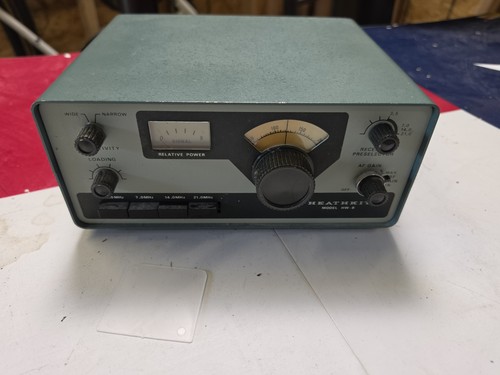
The HW-8 is Heath's little CW-only QRP transceiver, a 4 lb box covering the bottom 250 kHz of 80, 40, 20 and 15 m. Heath's manual is dated 1975, and its first service bulletin went out that October. Power is a few watts, rated by DC input, and the receiver is direct conversion with an RF stage and a switchable active audio filter. It sips 430 mA on transmit, so a car or lantern battery runs it, as the manual itself suggests. It built a loyal following among QRP operators, enough that one author writes of an HW-8 Handbook and the QRP Quarterly ran articles fixing its quirks. The HW-9 followed in 1984 with a superhet receiver and, with an option, more bands. Rigpix lists the HW-8 on sale until 1983.
CW portions of 80, 40, 20 and 15 m (bottom 250 kHz of each)
Modes
CW only
Power
DC input 3.5 W on 80 m, 3 W on 40 and 20 m, 2.5 W on 15 m
Receiver
Direct conversion, 1 µV; 750 Hz wide or 375 Hz narrow audio filter
Power supply
13.4 V DC nominal: 90 mA receive, 430 mA transmit
Finals
One 2N4427 transistor
Weight
4 lb (1.8 kg)
Also listed as
HW8, HW 8, Heath HW-8
Typical eBay ask (Oct 15, 2026)
$140–$150
Bench check
Power, receive, finals and supply
Transmit power
Heath rates it by DC input, 3.5 W on 80 m down to 2.5 W on 15 m, so the wattmeter will read less than that. Ask for a reading into a dummy load on all four bands. WA8MCQ found HW-8s making a quarter to half a watt on 80 or 40 m while 20 and 15 m were fine.
Receiver
It's a direct-conversion receiver with an RF stage and an active audio filter, rated at 1 µV or better for 10 dB S+N/N. Heath's 1975 service bulletin says poor sensitivity is usually Q1 or IC-1, and poor sensitivity on one band only is usually Q1. Ask whether it hears CW signals on all four bands, with the preselector peaked on a signal rather than on noise.
Finals
The final is a single 2N4427 transistor (Q9), with a zener diode to protect it if it's keyed into no load or high SWR. WA8MCQ traced low output on 80 and 40 m to the ferrite toroid cores in the output network, not the transistor. A healthy set makes similar power on all four bands.
Power supply
There's no supply inside. Heath sold the HWA-7-1 accessory supply, and the manual says any low-impedance supply or batteries near 13.4 V will do. It draws 430 mA on transmit, so a small 12 V battery runs it in the field.
Dial and display
Tuning is an analog dial on a premixed VFO, so it reads the same on every band. Heath specs drift under 150 Hz an hour after a 60-minute warm-up. Ask for a photo of the dial and whether it tunes smoothly end to end.
Filters and options
There are no crystal filters to add. Selectivity comes from the built-in active audio filter, 750 Hz wide or 375 Hz narrow, on a front-panel switch. Heath's bulletin notes the receiver gets louder in narrow, which is normal.
Should come with it
The HWA-7-1 accessory power supply, or a DC lead for a 12 V battery
The Heath manual, which holds the alignment steps
Check the listing photos against this list, and ask the seller about anything you can’t see. A missing piece should come off the price.
What to check
Low power on 80 or 40 m with 20 and 15 m fine is a known HW-8 fault: WA8MCQ traced it to ferrite toroid cores in the output network whose inductance had shifted. Poor receive sensitivity is usually Q1 or IC-1, per Heath's 1975 service bulletin.
01Power out: Ask for a wattmeter reading into a dummy load on 80, 40, 20 and 15 m. Similar power on all four bands, a little under the 2.5 to 3.5 W input ratings, is healthy.
02Receive: Ask whether it hears CW signals on all four bands. Peaking the preselector on a signal should bring it up clearly.
0380 and 40 m: Compare the 80 and 40 m output with 20 and 15 m. A big drop on the low bands points at the output toroids.
04Dial: Ask for a photo of the dial and whether it tunes smoothly across each band. The reading should match on every band.
05Audio filter: Ask the seller to switch between wide and narrow on a signal. Narrow should sound sharper and a bit louder.
06Power supply: Check for the HWA-7-1 supply or a DC lead in the photos. Any 12 to 13.4 V supply or battery will run it.
07Build quality: Ask for a photo of the circuit board. Neat joints and no burnt or missing parts suggest a careful builder.
08Model number: Check the panel reads HW-8. The HW-7 came before it and the HW-9 after.
One listing isn't a market read. backagainresale's HW-8 asks $146 delivered with no test claim and no supply, and it runs on about 13.4 V DC at 430 mA on transmit, so a small 12 V battery or bench supply will do. Ask for a wattmeter reading into a dummy load on all four bands, since WA8MCQ found HW-8s making a quarter to half a watt on 80 or 40 m while 20 and 15 m were fine, and ask whether it hears CW signals on each band. It's CW only, and you don't need a license to own or listen with one, but transmitting needs an amateur license.
Listed now
1
For parts
0
Typical ask
$140–$150
Full range
$100–$100
★Cheapest
$145.54est. delivered
The only HW-8 for sale, at $146 delivered from a 99.2% seller. It isn't titled tested, so ask for power readings on all four bands, since low output on 80 or 40 m is a known HW-8 fault.
Heathkit HW-8 Ham Radio Transceiver HF Mono Band 3.5-21MHz 13V DC Green Vintage
Delivered prices include shipping as eBay quoted it to a US address on Oct 15, 2026. Many sellers charge by distance, so your total may differ. eBay shows yours before you pay.
Snapshot
For sale on eBay
1 of 1 listed
Checked . Some may have sold.
Delivered prices include shipping as eBay quoted it to a US address on Oct 15, 2026. Many sellers charge by distance, so your total may differ. eBay shows yours before you pay.
Used
★Cheapest
Heathkit HW-8 Ham Radio Transceiver HF Mono Band 3.5-21MHz 13V DC Green Vintage
$145.54est. delivered
$99.99 + $45.55 shipping
Buy It Now$99.99
Good buy
No test claim or supply titled. Photo shows it switched off.